Megan Tesch


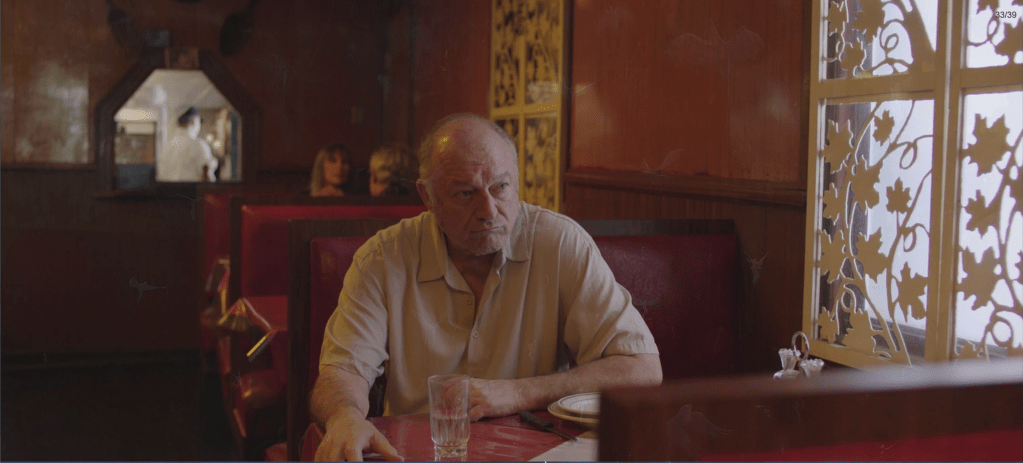


Sell By (2019) had amassed a great deal of attention before it arrived at the Reelout Queer Film Festival in Kingston. As a directorial debut from screen writer, actor, and, now, director Michael Dole, this film has been part of the official selection for over 20 film festivals and received various awards. Above all else, it is important to note that the cinematography from Ludovic Littee and music from Dabney Morris allows the audience to truly enjoy the subtleties in the actors and actresses performances, as the blue grey tones in many scenes and deep melodies are there to emphasize the characters’ story, not distract from them. The film follows two men, Adam and Marklin, in the midst of their 30s’ as they struggle to redefine their relationship and figure out where it stands in their lives. This is not without issues arriving in their support system’s lives as well, as Cammy engages in a relationship with a man living in a homeless shelter, Haley has turned the eye of one of her high-school students, and Elizabeth is considering divorce with her husband of 15-years. This film discusses a vast array of issues that are not exclusive to LGBTQ+ relationships, but to romantic relationships at large, in a light-hearted and airy manner.
Adam and Marklin’s same-sex relationship was normalized throughout the film as it was depicted as equal to the various heterosexual relationships. The script would likely not have been changed much if this were a heterosexual couple. Stuart Hall’s theory on encoding and decoding film and media is evident in this film, as it states that messages may be encoded into televisual stories and the apparent naturalness of televisual codes disguises their ideological potential (Jenkins 384). In this framework, the creators of this film encoded the message that same-sex relationships are not to be emphasized or understated, and the audience can decode that norms in society should be changed to reflect the world represented in this film. Further, all of the heterosexual relationships depicted in this film (Elizabeth and Damon, Cammy and Henry, Haley and Scott) are all inter-racial. This fulfils the ever-growing need in film for greater representation and integration of races within couples. This especially works to challenge the romantic comedy norms, of which this is the film’s genre. Romantic comedies are typically white, heterosexual couples (Moddelmog 163). As Sell By works to break both race and sexual orientation norms, it does so with a light touch. When considering intersectionality, an important theme in any discussion on sexuality and race, Sell By falls flat.
Adam and Marklin are not depicted as victims of bigotry, but there are a few instances that depict their struggles with homophobia living in Western society. Despite the evident rise of hate speech in contemporary online platforms (Cooper 244), Marklin, a social media influencer, is not shown as a target for any such comments. The very few moments of such hate speech are nuanced into the film to show how although it exists, this is not a movie about homophobia. However, when contrasted against a character like Cammy, a woman of colour, intersectional points of discrimination are not discussed once. Intersectionality is a theory from American lawyer, activist, and scolar Kimberle Crenshaw that emphasizes how different systems of power, including gender, race, and class, intersect to create different degrees of oppression and discrimination (Ahmed 119). Cammy’s story lays equal to the rest of the characters, and yet the struggles that could potentially impact her life are not depicted. Perhaps this is an issue on the hands of the quality of the script, but nonetheless, it is a missed opportunity for flushed out representation. Tokenism is the use of diverse characters without representing them in a significant and nuanced way (“Forced Diversity…”). True representation counts in films such as these; token diversity characters do not deserve a place in the award – winning category.
The way in which one particular character is depicted shadows a poor light on a large community with the United States; the homeless. The homeless are a group that has been highly debated amongst policy makers and government agencies alike (Honig and Filer 248). This is similar to those of the LGBTQ+ community and African Americans within the United States. Henry, Cammy’s homeless boyfriend, is constantly berated throughout the film for spending nights in a shelter. At one point in the film, Cammy states in exasperation, “what white guy in his thirties is homeless?” Further, it is not only in Henry’s interactions with other characters that he is criticized, but the way in which he acts as well. The way Henry is written has him stunned by the wealth of Cammy and her friends, who, apart from Marklin, are presumably lower to middle class. When discussing the reasons for Henry’s situation, the most the audience receives as an explanation is that he would rather stay in the shelter than get a job. This is a false representation of homelessness, as common causes of homelessness are based on mental and/or health issues, rent prices and systematic forms of oppression (Honig and Filer 248).
Sell By is not a movie about sexuality, race, or even class. It is instead a movie about friendship and romantic relationships that crosses boundaries. It works to challenge heteronormativity, which is the enforcement of heterosexuality on the population, without falling victim to homonormativity, wherein the norms and values of heterosexuality are replicated and performed in the LGBTQ+ community (Eeden-Moorefield 563). These are commonly apparent themes in romantic comedies. Through this, the film allows for audience members that fit into the romantic comedy tropes of race and sexuality to relate to this film and the characters’ stories, as they are not stories about sexual orientation or race, but instead about relationships and the issues that anyone may face in such situations. However, this film also allows for those that relate to the sexual orientation or race of the characters to see lives similar to their depicted as a norm in society, without the need for explicit clarification or the use of stereotypes. Sell By is a film that has the potential to alter how the LGBTQ+ community is viewed in film, if only it included a greater discussion of intersectionality.
Works Cited
Ahmed, Sarah. “Being In Question.” Living a Feminist Life, Duke University Press, 2017, pp. 116–125.
Cooper, Cynthia A. “Anti-Gay Speech On The Internet and The Movement To Counteract Cyber Hate.” Race/Gender/Class/Media 3.0: Considering Diversity across Audiences, Content, and Producers, 3rd ed., Pearson, 2013, pp. 244–250.
Eeden-Moorefield, Brad Van, et al. “Same-Sex Relationships and Dissolution: The Connection Between Heteronormativity and Homonormativity.” Family Relations, vol. 60, no. 5, 2011, pp. 562–571., doi:10.1111/j.1741-3729.2011.00669.x.
“Forced Diversity – Tokenism vs True Diversity.” Youtube, uploaded by Pixel_Hipster, 27 May 2019, https://www.youtube.com/watch?v=sGjV-3M_nJw.
Honig, Marjorie, and Randall K. Filer. “Causes of Intercity Variation in Homelessness.” The American Economic Review, vol. 83, no. 1, Mar. 1993, pp. 248–255., http://www.jstor.org/stable/2117507.
Jenkins, Henry. “Negotiating Fandom: The Politics of Racebending.” The Routledge Companion to Media Fandom, 1st ed., Routledge, 2017, pp. 383–393.
Moddelmog, Debra A. “Can Romantic Comedy Be Gay?: Hollywood Romance, Citizenship, and Same-Sex Marriage Panic.” Journal of Popular Film and Television, vol. 36, no. 4, 2009, pp. 162–173., doi:10.3200/jpft.36.4.162-173.
Word count: 1,040
 Reelout+ Film Festival