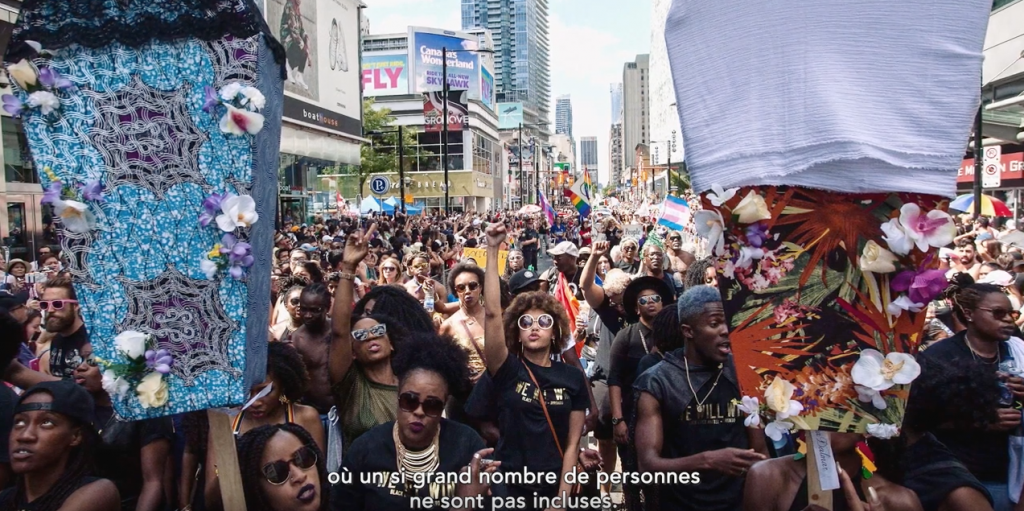
The film that I watched at reelout was called sex, sin and ’69, in reference to the year when they legalized gay marriage. The film was a documentary that when through time and showed how we got to where we are today in terms of acceptance of various minorities such as sex, race, gender and so on. It started off referencing back to the 1500s, where in Indigenous cultures, being two-spirited was considered normal, proving that not across all cultures and times, has it been viewed that everyone is binary. The film also discusses the issue we have discussed lots in class, intersectionality, which is the axes of oppression and how they intersect with each other causing further discrimination then when they are experienced individually. Throughout history, white gay men have had the easiest time being accepted for being gay in comparison to other communities. Specifically, it addressed the stigmatization for Muslims, where they have a much more difficult time expressing their homosexuality because it is proposed that Muslims cannot be gay due to intersectionality. White males throughout history have maintained superiority and dominance over everyone else. These impacts are still seen today in our education system. In this film, a female teacher demonstrated her way of seeing such in her classroom. She asked all of her students to write down a list of all the non-white males they have learned about in history class in school. The students list either contained no names or very view. Furthermore, demonstrating that the white male view, even today, still overthrows every other race, gender and sexuality background, and although circumstances have improved, the issue of white male superiority is still prevailing in the twenty-first century. This teacher’s demonstration in the film truly caused me to reflect on my educational experience, prior I was truly oblivious and failed to notice the white male supremacy that still is apparent in our current educational system, which is truly sad. The documentary went on to talk about the year of 1969, the year where gay marriage was finally legalized. I presumed that this legalization meant that gay marriage was finally accepted by everyone and people no longer had a significantly heterosexual mindset. However, as the film went on, I learned that although the legalization was a big step forward, that the legalization in itself did not entail that people were accepting on homosexuality. In reality, the police and the catholic church remained very homophobic and continued to discriminate against homosexuals, regardless of the new law change. The first gay marriage took place January 2001 in Toronto. The officiator of this marriage spoke, he explained of how fearful he was to conduct this marriage, he was very threatened that he feared harm. He had to wear a bulletproof vest that day because he feared someone with homosexual views would attempt to shot him. No one ended up shooting him, but earlier that day he was assaulted. He also went on to say that before the marriage ceremony he called his loved ones in case he did not make it out alive of the officiation. 2001 is thirty-two years after the legalization of gay marriage, yet people were still very fearful of getting married because even thought it was legal, it still remained impermissible. The film also discussed bath houses in Toronto, which were safe places for gay people to socialize. During the eighties the police raided the bath houses, were verbally abusive, and arrested innocent people. The police caused over 50,000 in damages to the bath houses. All of which served to enforce that heteronormative constructions of society will prevail. The film also referenced a monthly magazine series called body politic which were sold in Canada during the seventies and eighties. These magazines were gay focused. One of the articles was titled “Men loving boys loving men.” After its publication the offices were raided in Toronto and members were charged with “possession of obscene materials for distribution” and “use of mails to distribute immoral, indecent and scurrilous materials.” This caused serve emotional and economical damage. These magazines allowed communication amongst queer communities in Canada and played a significant role in developing Canadas LGBTQ+ community. After Pierre Trudeau was elected, some historical advancements took place. He instilled the charter of rights and freedoms. In one of his public speeches he declared, “There is no place for the state in the bedrooms of the nation.” This line signifies the first time that any member in the Canadian parliament explicitly expressed that the affairs of Canadian citizens, regarding one’s gender, sexual orientation etc. it is not their place to insert themselves. The role of a prime minister does not entail embedding themselves into Canadians personal matters. Furthermore, enforcing that he will not try to interfere in people’s lives just because they do not comply to the heteronormative standards. This marked a big step forward in accepting minorities in Canada. Homosexual acts were no longer able to be criminalized due to Pierre Trudeau’s revision. Overall, throughout Canadian history discrimination against minorities has improved and we have come a long way from where. We started and are certainly becoming more accepting. However, let us not dismiss the ongoing and current issues minorities are facing. The film brought up many modern-day statistics that deserve our attention. Twenty-three percent of the current homeless youth are members of the LGBTQ+ community. This community also faces hate crimes which entail the most amount of violence, which is very concerning. Today, non-cisgender people are still viewed as a problem that must be fixed and are assumed to be psychologically ill. Non-cisgender people have a greater risk for suicide and unemployment, as they cannot access as many job opportunities. With all of the continuous challenges, Canada still remains advanced over most countries. As of 2019, sixty-nine countries still criminalize homophobic marriage. Ultimately, the reelout film sex, sin and ’69 was a very education documentary marking Canadas progression in accepting minorities and discussing the ongoing issues we must continue to conquer today.
-Katarina Astrom, 1005 Words



 Reelout+ Film Festival